Pod Isolation Actions
Terminate, quarantine, or label pods in a connected Kubernetes cluster from the RAD Security UI or API
Overview
Pod isolation actions let you respond to a threat directly from RAD Security — without leaving the platform and without kubectl access to the cluster. When you create an action, RAD Security queues it for the cluster, and the rad-sync plugin already running in that cluster picks it up and applies the change through the Kubernetes API.
Three action types are available:
| Action type | What it does | Kubernetes operation |
|---|---|---|
terminate_pod | Permanently deletes the target pod | DELETE on v1/pods |
disable_outbound | Quarantines the pod: applies quarantine labels and creates a deny-all-egress NetworkPolicy | PATCH on v1/pods + CREATE on networking.k8s.io/v1/networkpolicies |
label_pod | Applies labels to the target pod | Merge-patch on v1/pods |
Actions are available both from the Actions tab of a cluster in the UI and from the Cluster Actions API. Every action — whichever way it was created — is recorded with its author, timestamps, and execution result.
Actions target pods. To isolate a workload permanently, address the controller (Deployment, StatefulSet, DaemonSet) as well — see Terminate Pod.
Prerequisites
The cluster is connected to RAD Security and the sync plugin is running and healthy. The plugin status is shown on the Overview tab of the cluster details panel. See Kubernetes Setup and rad-sync.
The rad-sync ClusterRole grants the permissions the actions require. The default Helm chart already includes them:
- apiGroups: [ "" ]
  resources: [ "pods", "pods/log" ]
  verbs: [ "get", "list", "delete", "update", "patch" ]
- apiGroups: [ "networking.k8s.io" ]
  resources: [ "networkpolicies" ]
  verbs: [ "create", "update", "get" ]
Your RAD Security user or access key has modify permission on the account. Listing and viewing actions requires read permission.
disable_outbound creates a Kubernetes NetworkPolicy. NetworkPolicies are only enforced if your cluster runs a CNI that implements them (Calico, Cilium, Weave Net, and most managed CNIs). With a CNI that ignores NetworkPolicies, the object is created successfully and the action reports Executed, but traffic is not blocked.
How execution works
The action is created
You submit an action from the UI or the API. RAD Security stores it with status Pending and returns an action ID in the form ca-<ksuid>.
rad-sync picks it up
The rad-sync plugin in the target cluster polls RAD Security for pending work. The default poll interval is 60 seconds (sync-interval), so an action typically starts executing within a minute.
The change is applied
rad-sync applies the operation with the Kubernetes API using the cluster's own service account — RAD Security never connects inbound to your cluster.
The result is reported back
rad-sync reports the outcome, and the action moves to Executed or Failed. The result field carries the message shown in the UI, for example Resource default/nginx-new has been deleted.
Failures are retried
A failing action is retried on each sync cycle up to 5 times (max-sync-retries). After that it is marked Failed with a result of Max retries reached: 5. Last error: ....
Action statuses
| Status | Meaning |
|---|---|
Pending | Queued; not yet picked up or still being retried by rad-sync |
Executed | Applied successfully in the cluster |
Failed | Could not be applied — see result for the Kubernetes error |
Using the UI
Open Data Sources → Connections → Clusters, select the cluster, and open the Actions tab.
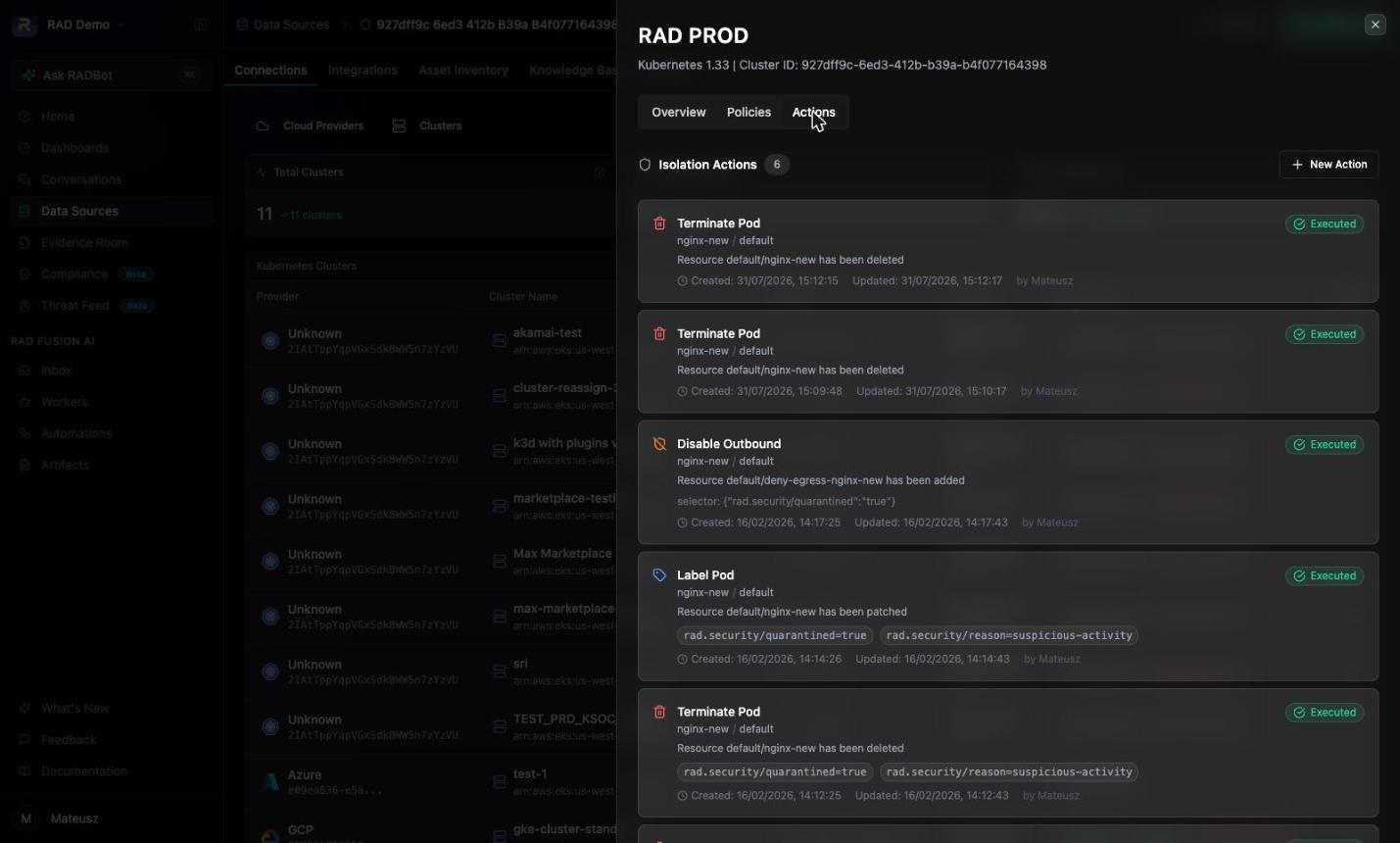
The tab lists every isolation action for the cluster, newest first, with its type, target pod and namespace, applied parameters, status, result message, timestamps, and the user who created it. While an action is pending, the list refreshes automatically every few seconds.
Creating an action
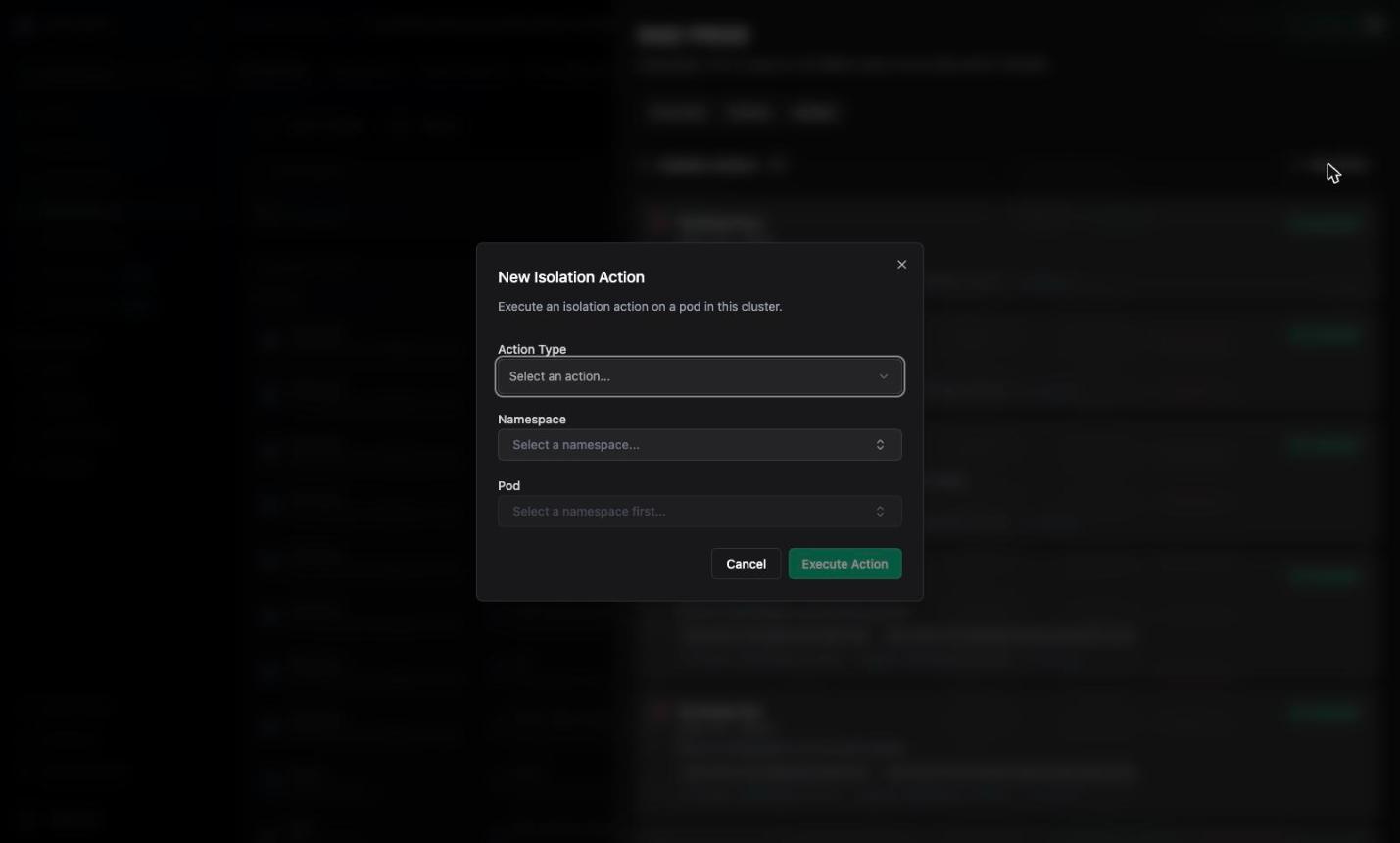
Open the dialog
Select New Action in the top right of the Actions tab.
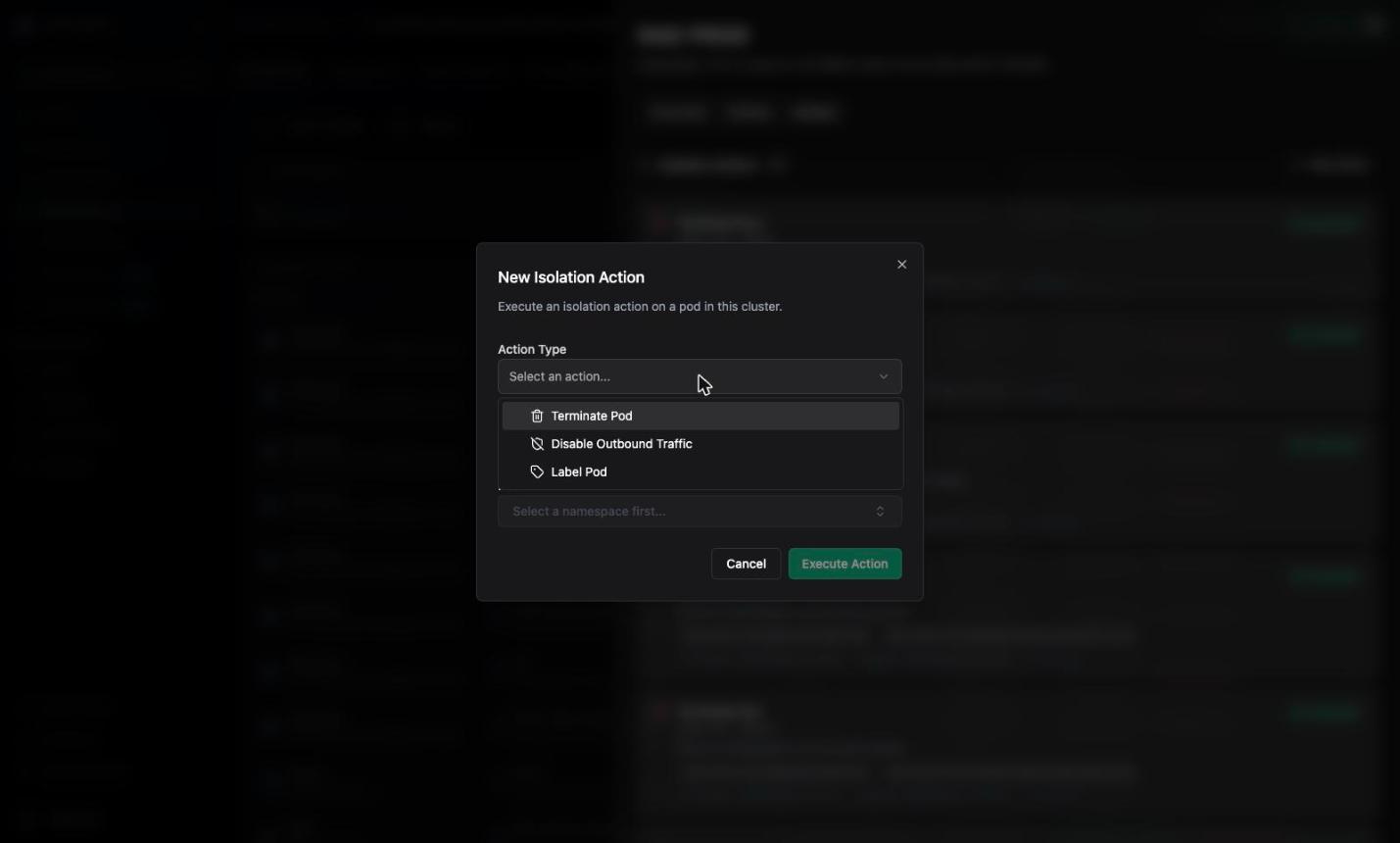
Choose the action type
Pick Terminate Pod, Disable Outbound Traffic, or Label Pod. A short description of the selected action appears under the field.
Select the namespace
Namespaces are loaded from the cluster inventory and can be filtered by typing.
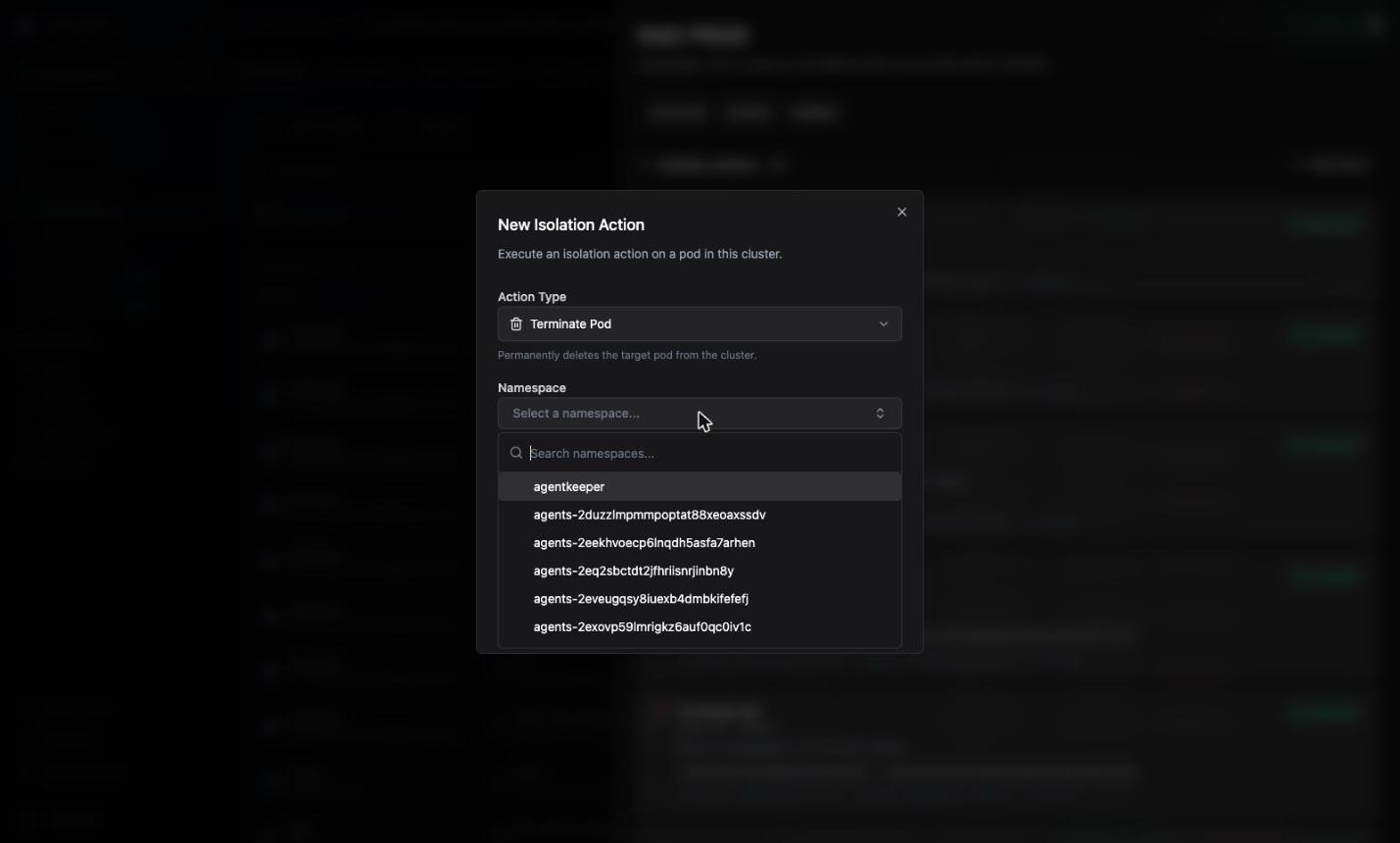
Select the pod
The pod list is scoped to the namespace you selected. Changing the namespace resets the pod selection.
Fill in action-specific fields and confirm
For Label Pod, add one or more key/value pairs. Then confirm with the action button — Terminate Pod, Disable Outbound, or Apply Labels.
The new action appears in the list as Pending and updates to Executed or Failed on its own once rad-sync has processed it.
Terminate Pod
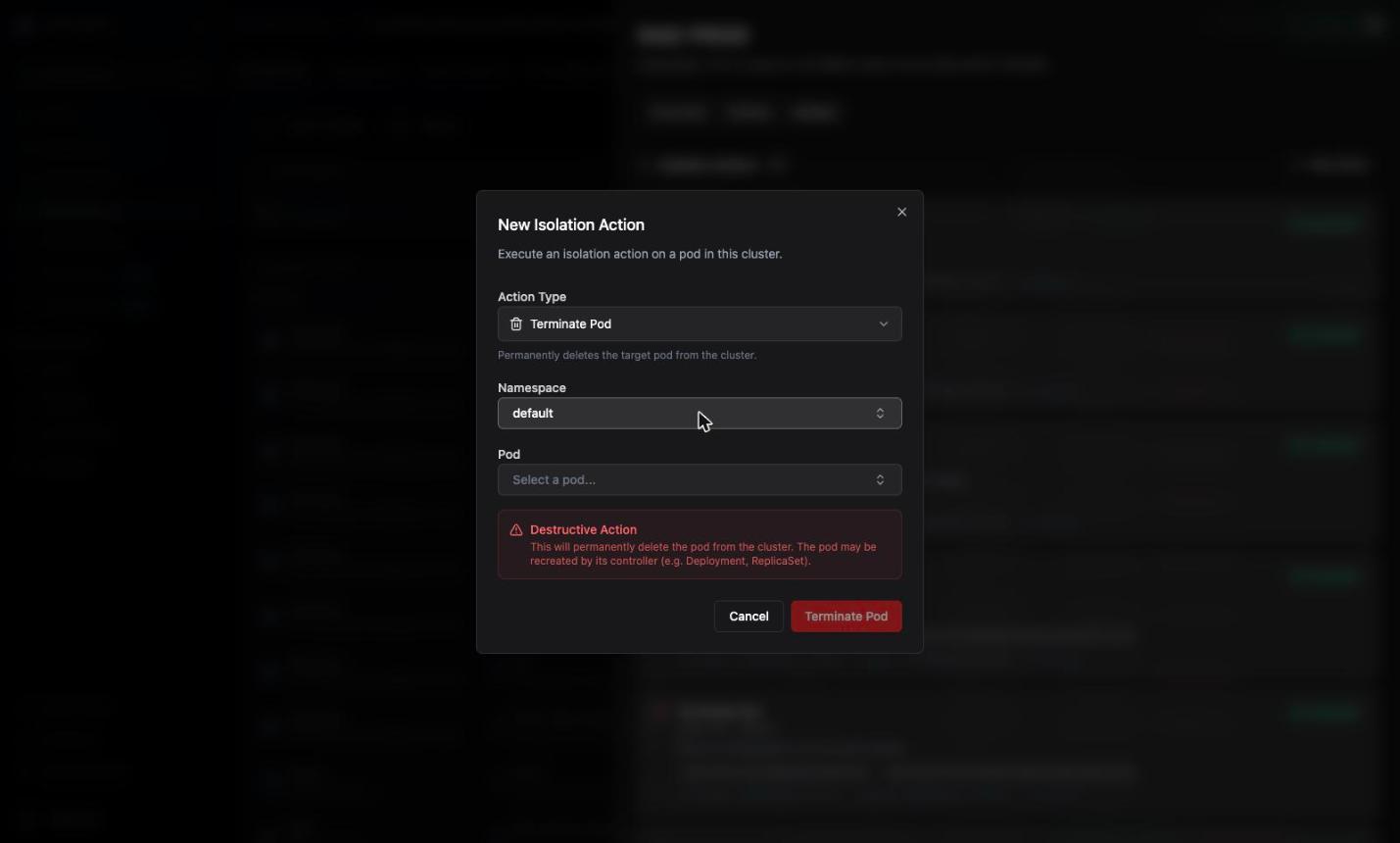
Deletes the pod from the cluster.
This is destructive and cannot be undone. If the pod is managed by a controller (Deployment, ReplicaSet, StatefulSet, DaemonSet), the controller recreates it, typically within seconds and with the same image. Use termination to kill a running process immediately, then follow up by scaling down or removing the controller.
Disable Outbound Traffic
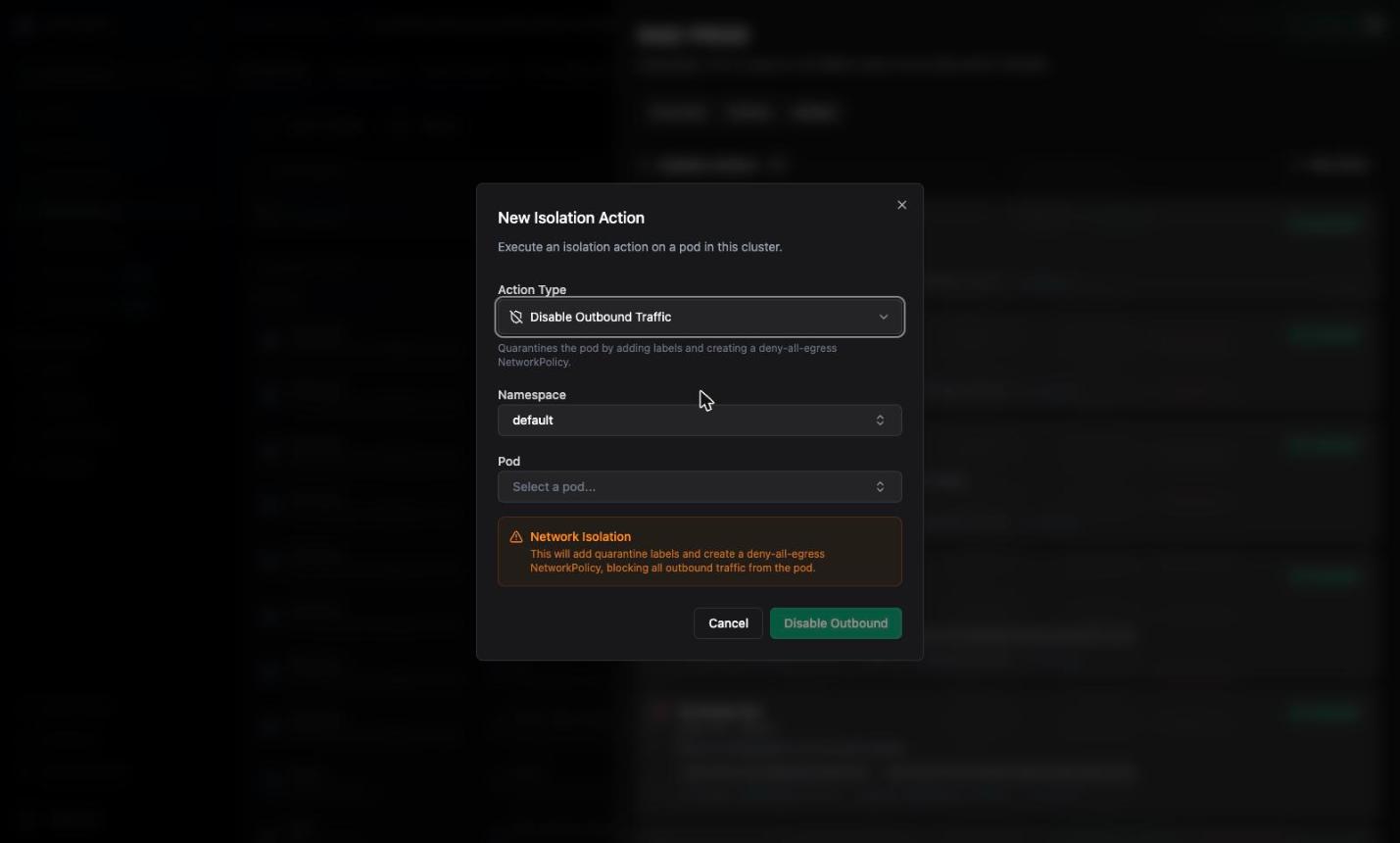
Quarantines the pod so it can no longer initiate outbound connections. A single request expands into two actions:
-
A
label_podaction that applies the quarantine labels to the target pod:rad.security/quarantined: "true" rad.security/quarantine_id: "<generated id>" -
A
disable_outboundaction that creates a deny-all-egressNetworkPolicynameddeny-egress-<quarantine_id>in the pod's namespace, selecting exactly those labels:apiVersion: networking.k8s.io/v1 kind: NetworkPolicy metadata: name: deny-egress-<quarantine_id> namespace: <target namespace> annotations: rad.security/created-by: rad-cluster-action spec: podSelector: matchLabels: rad.security/quarantined: "true" rad.security/quarantine_id: "<quarantine_id>" policyTypes: - Egress egress: []
Because the policy selects a unique quarantine_id, each quarantine is independent — quarantining a second pod in the same namespace does not widen or replace the first policy.
The quarantine follows the labels, not the pod. If the pod is deleted and its controller creates a replacement, the new pod has no quarantine labels and is not covered by the policy. Quarantine the replacement as well, or scale the controller down.
Ingress traffic is not affected. The policy sets policyTypes: [Egress] only, so existing connections into the pod and its Service continue to work. That is deliberate: it keeps the pod reachable for forensics while cutting off command-and-control and data exfiltration.
Label Pod
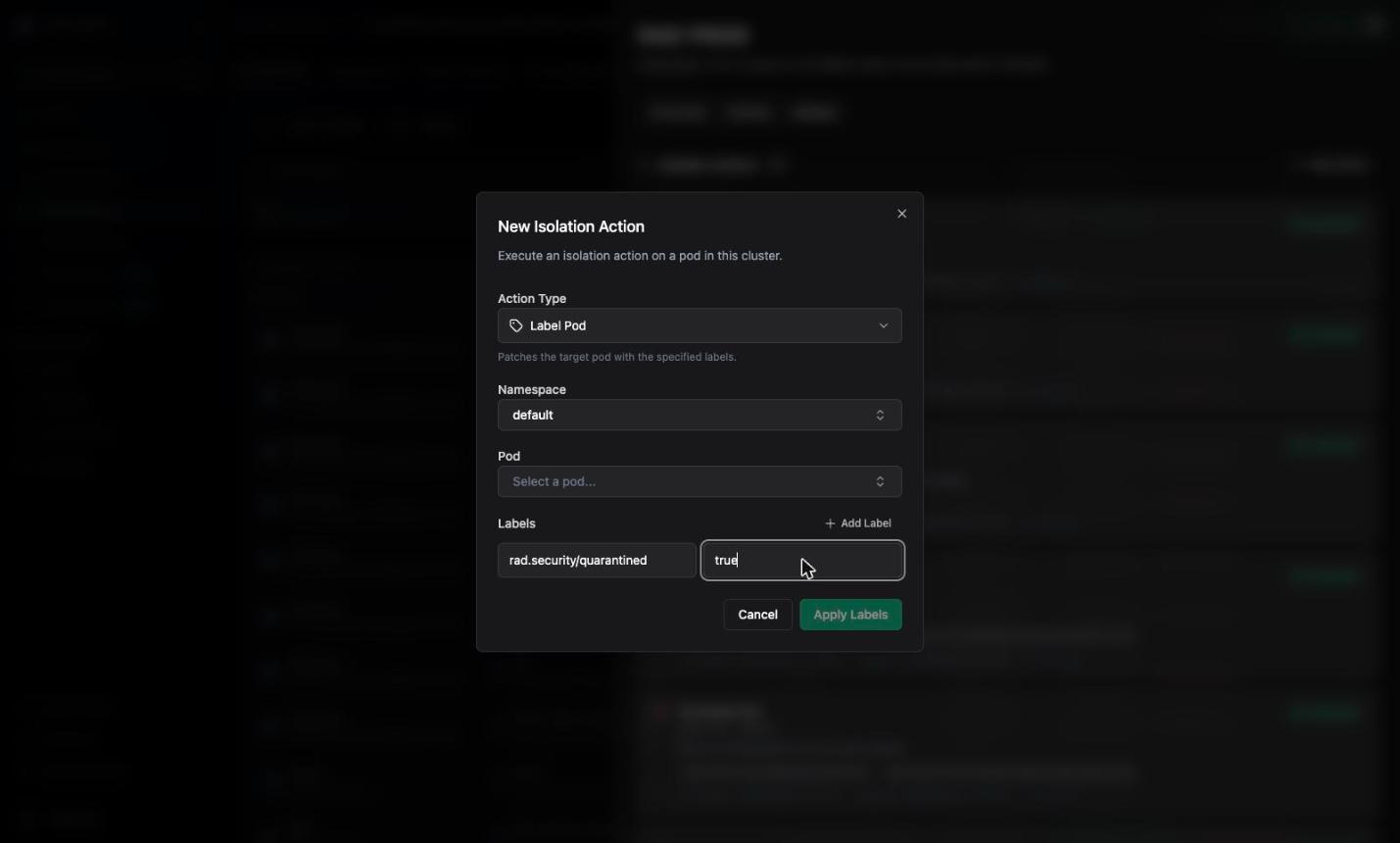
Merge-patches metadata.labels on the target pod. Existing labels that you do not name are left untouched.
Labels are useful to mark a pod for follow-up tooling — for example to make it selectable by your own NetworkPolicies, admission controls, or dashboards:
rad.security/quarantined: "true"
rad.security/reason: "suspicious-activity"
Keys and values must satisfy Kubernetes label syntax; invalid labels are rejected before the action is queued. See Label validation rules.
Removing a quarantine
There is no "undo" action. To lift a quarantine, remove the objects in the cluster directly:
# Remove the deny-all-egress policy
kubectl delete networkpolicy deny-egress-<quarantine_id> -n <namespace>

# Remove the quarantine labels from the pod
kubectl label pod <pod> -n <namespace> \
  rad.security/quarantined- rad.security/quarantine_id-
The quarantine_id is shown on the action entry in the Actions tab and returned in the action's parameters.
API reference
All endpoints are served from https://api.rad.security.
Authentication
Create an access key in Settings → Access Keys, exchange it for a session token, and send the token as a bearer token. See Managing API Keys.
TOKEN=$(curl -s 'https://api.rad.security/authentication/authenticate' \
  -d '{"access_key_id":"<key id>","secret_key":"<secret key>"}' | jq -r .token)
Create actions
POST /accounts/{account_id}/clusters/{cluster_id}/actions
The request body is an array, so several actions can be queued in one call. Returns 201 Created with the created actions.
curl -X POST \
  "https://api.rad.security/accounts/$ACCOUNT_ID/clusters/$CLUSTER_ID/actions" \
  -H "Authorization: Bearer $TOKEN" \
  -H "Content-Type: application/json" \
  -d '[
        {
          "action_type": "terminate_pod",
          "target_pod_name": "nginx-new",
          "target_namespace": "default"
        }
      ]'
curl -X POST \
  "https://api.rad.security/accounts/$ACCOUNT_ID/clusters/$CLUSTER_ID/actions" \
  -H "Authorization: Bearer $TOKEN" \
  -H "Content-Type: application/json" \
  -d '[
        {
          "action_type": "disable_outbound",
          "target_pod_name": "nginx-new",
          "target_namespace": "default"
        }
      ]'
curl -X POST \
  "https://api.rad.security/accounts/$ACCOUNT_ID/clusters/$CLUSTER_ID/actions" \
  -H "Authorization: Bearer $TOKEN" \
  -H "Content-Type: application/json" \
  -d '[
        {
          "action_type": "label_pod",
          "target_pod_name": "nginx-new",
          "target_namespace": "default",
          "parameters": {
            "labels": {
              "rad.security/quarantined": "true",
              "rad.security/reason": "suspicious-activity"
            }
          }
        }
      ]'
curl -X POST \
  "https://api.rad.security/accounts/$ACCOUNT_ID/clusters/$CLUSTER_ID/actions" \
  -H "Authorization: Bearer $TOKEN" \
  -H "Content-Type: application/json" \
  -d '[
        {
          "action_type": "label_pod",
          "target_pod_name": "api-7d9f",
          "target_namespace": "payments",
          "parameters": { "labels": { "rad.security/reason": "triage" } }
        },
        {
          "action_type": "disable_outbound",
          "target_pod_name": "api-7d9f",
          "target_namespace": "payments"
        }
      ]'
Request fields
| Field | Type | Required | Description |
|---|---|---|---|
action_type | string | yes | terminate_pod, disable_outbound, or label_pod |
target_pod_name | string | yes | Name of the pod to act on |
target_namespace | string | yes | Namespace of the pod |
parameters | object | for label_pod | Action parameters. label_pod requires parameters.labels — a non-empty map of string keys to string values |
Response
[
  {
    "id": "ca-2rF9xQ8mS1kLp7vTn3JcYwZ0aBd",
    "cluster_id": "927dff9c-6ed3-412b-b39a-b4f077164398",
    "account_id": "2IAtTppYqpVGxSdkBWW5n7zYzVU",
    "action_type": "terminate_pod",
    "status": "Pending",
    "target_pod_name": "nginx-new",
    "target_namespace": "default",
    "parameters": {},
    "created_by": "b1f1c6d2-8f5a-4a0e-9d3e-1c2f4a6b8d0e",
    "created_at": "2026-07-31T15:12:15.482Z",
    "updated_at": "2026-07-31T15:12:15.482Z"
  }
]
A single disable_outbound request returns two action objects — the label_pod action that applies the quarantine labels and the disable_outbound action that creates the NetworkPolicy. Both must reach Executed for the pod to be quarantined. The generated quarantine_id is in the parameters of both.
List actions
GET /accounts/{account_id}/clusters/{cluster_id}/actions
Returns every action for the cluster, newest first.
curl "https://api.rad.security/accounts/$ACCOUNT_ID/clusters/$CLUSTER_ID/actions" \
  -H "Authorization: Bearer $TOKEN" | jq .
{
  "entries": [
    {
      "id": "ca-2rF9xQ8mS1kLp7vTn3JcYwZ0aBd",
      "cluster_id": "927dff9c-6ed3-412b-b39a-b4f077164398",
      "account_id": "2IAtTppYqpVGxSdkBWW5n7zYzVU",
      "action_type": "terminate_pod",
      "status": "Executed",
      "target_pod_name": "nginx-new",
      "target_namespace": "default",
      "parameters": {},
      "result": "Resource default/nginx-new has been deleted",
      "created_by": "b1f1c6d2-8f5a-4a0e-9d3e-1c2f4a6b8d0e",
      "created_at": "2026-07-31T15:12:15.482Z",
      "updated_at": "2026-07-31T15:12:17.913Z"
    }
  ],
  "page_count": 1,
  "total_count": 1,
  "page": 1,
  "page_size": 1
}
Get an action
GET /accounts/{account_id}/clusters/{cluster_id}/actions/{action_id}
Use this to poll a single action until it leaves Pending.
curl "https://api.rad.security/accounts/$ACCOUNT_ID/clusters/$CLUSTER_ID/actions/$ACTION_ID" \
  -H "Authorization: Bearer $TOKEN" | jq '.status, .result'
Action object
| Field | Type | Description |
|---|---|---|
id | string | Action ID, prefixed with ca- |
cluster_id | string | Target cluster |
account_id | string | Owning account |
action_type | string | terminate_pod, disable_outbound, or label_pod |
status | string | Pending, Executed, or Failed |
target_pod_name | string | Pod the action was created for |
target_namespace | string | Namespace of the pod |
parameters | object | Action parameters — labels for label_pod, quarantine_id for disable_outbound |
result | string | Message reported by rad-sync after execution; the Kubernetes error when Failed |
created_by | string | Identity that created the action |
created_at | string | RFC 3339 timestamp |
updated_at | string | RFC 3339 timestamp of the last status change |
Validation rules
Requests are validated before anything is queued. A rejected request returns 400 and creates no actions — including the other entries in the same batch.
| Condition | Error |
|---|---|
Unknown action_type | invalid action_type: must be one of terminate_pod, disable_outbound, label_pod |
Missing target_pod_name | Invalid input on field target_pod_name |
Missing target_namespace | Invalid input on field target_namespace |
label_pod without parameters.labels | Invalid input on field parameters.labels |
| Non-string label value | Invalid input on field parameters.labels.<key> |
| Label key or value breaking Kubernetes syntax | Invalid input describing the offending key |
Validation does not check that the pod exists. An action targeting a missing pod is accepted, then reported as Failed by rad-sync with the Kubernetes "not found" error.
Label validation rules
| Element | Rule |
|---|---|
| Key name segment | 1–63 characters; alphanumerics, -, _, .; must start and end with an alphanumeric |
Key prefix (optional, before /) | Valid DNS subdomain, at most 253 characters — for example rad.security/quarantined |
| Value | At most 63 characters, same character set as the key name segment; may be empty |
| Label map | Must contain at least one entry |